Showing posts with label Maths. Show all posts

Monday, 17 March 2025

Bridging the Gap: Enhancing Maths Engagement and Understanding Through Real-Life Contexts

 By Nadir Jebari


Many students see mathematics as abstract, irrelevant to their daily lives, and sometimes even daunting. As teachers, one of the most effective ways to change this perception is by making maths feel more connected to the real world. Bringing real-life examples into lessons helps students see the practical side of what they’re learning, making it more engaging and easier to understand. Here’s how you can put this approach into practice and assess its impact.

Why Use Real-Life Examples?

Using real-life examples in maths lessons isn’t just about telling stories – it’s a powerful way to help students understand tricky concepts. When they can see how maths connects to real life, it becomes more interesting and easier to grasp. For example, looking at payslips to understand tax and income or using cryptocurrency trends to explore percentages and growth can really grab their attention. Linking maths to things like money management and new technology shows students that what they learn in class actually matters in the real world.


Strategies for Using Real-Life Examples

Bringing maths to life with real-world examples helps students understand why it matters. Here are some simple ways to make different maths topics more relevant and engaging:

  • Algebra: Show students how algebra is useful in everyday life by having them budget for a grocery shop or plan expenses for a trip. They can also use equations to split costs with friends or compare phone contracts.

  • Geometry: Link geometry to real-world professions like architecture, where angles, areas, and shapes are key to designing buildings. Map reading is another great way to explore scale and distance by planning routes.

  • Data & Statistics: Use sports to make data fun—students can analyse player stats, win rates, or even predict match outcomes. Class surveys are another hands-on way to collect and interpret data through graphs.

  • Fractions, Percentages & Ratios: Everyday activities like shopping and cooking are full of maths. Students can work out sale prices, VAT, or recipe adjustments to see percentages and ratios in action.

  • Probability: Make probability more exciting with games like dice rolling, card games, or even predicting the weather. These activities make the topic more hands-on and engaging.

  • Financial Maths: Teach essential life skills by discussing savings, interest rates, and loans. Currency exchange is another useful way to introduce ratios and percentages in a global context.

  • Time & Scheduling: Help students improve their time management by working with timetables, planning journeys, or organising daily schedules. These tasks make elapsed time calculations more practical.

By using examples that students can relate to, maths becomes more meaningful and useful beyond the classroom.

Collecting Data to Evaluate Effectiveness

To measure the impact of these strategies, data collection is essential. Gathering feedback from students through surveys or questionnaires allows us to assess engagement and understanding. Questions like, “Did this lesson help you understand the topic better?” or “Did you find the examples interesting?” can provide valuable insights. Additionally, using exit tickets with quick prompts such as, “What example helped you the most today?” can help gauge immediate responses.

Class discussions offer another avenue for student feedback, enabling open conversations about which real-life examples they found most useful. Performance data, such as comparing test scores or homework completion rates before and after implementing real-life examples, can provide quantitative evidence of impact.

Gathering insights from staff is equally important. Department surveys can help evaluate whether colleagues have observed increased engagement among students. Peer observations allow teachers to provide qualitative feedback on how students are responding to the lessons. Finally, staff meetings can be used to discuss findings, share successes, and refine approaches for even greater impact.

Analysing and Presenting Data

Quantitative data from surveys and performance scores can be used to generate statistics that measure changes in engagement and understanding. Presenting this information in the form of bar graphs or pie charts helps illustrate trends clearly. Qualitative data, such as recurring themes in student and staff feedback, can highlight which real-life examples were most effective and why.

A robust approach to evaluation involves triangulating data from multiple sources—student surveys, peer observations, and test scores—to draw well-rounded conclusions. By embedding real-life examples into maths lessons and systematically evaluating their effectiveness, we can make mathematics more accessible and meaningful for students.

Not only does this approach enhance engagement, but it also equips students with practical skills they can apply in their daily lives. The goal is clear: bridge the gap between theory and application, showing students that maths is everywhere—and it matters.

Tuesday, 28 January 2025

Teaching for Mastery Sustaining Workgroup: A Professional Development Journey

By Swapna Agarwal and Aditi Rudra


Aditi and I have been attending the Teaching for Mastery Sustaining Workgroup, a professional development initiative led by the National Centre for Excellence in the Teaching of Mathematics (NCETM). This program aims to support teachers embed the mastery approach into everyday teaching practices, focusing on helping students achieve a deep and sustainable understanding of mathematical concepts.


Fluency 

In our first session, we explored the core mastery principle of fluency in learning. Fluency is more than just knowing the "right answer"—it’s about combining efficiency, accuracy, and flexibility to solve problems with confidence and adaptability. To develop fluency, we focused on designing tasks that push students beyond traditional memorization and procedural thinking. Here’s an example: 

3 x 0.5 x 8

Most students approach this calculation from left to right. While this method works, it isn’t the most efficient. A more fluent approach leverages the commutative law of multiplication to reorder the numbers. Instead, multiplying 0.5 x 8 first, allows the calculation to be completed more efficiently. This approach not only simplifies the process but also demonstrates flexibility in thinking—students recognize that the order of multiplication can be adjusted to make calculations easier. Students were then able to take this exercise forward when looking at more complex calculations such as calculating the volume of a cuboid or multiplying numbers in standard form. 


This led to our first key takeaway: the vital role of question design in developing fluency. Carefully crafted tasks can challenge students’ conventional thinking and encourage them to explore more efficient and flexible strategies. This, in turn, deepens their understanding and builds a more robust foundation for problem-solving.


Mathematical Thinking

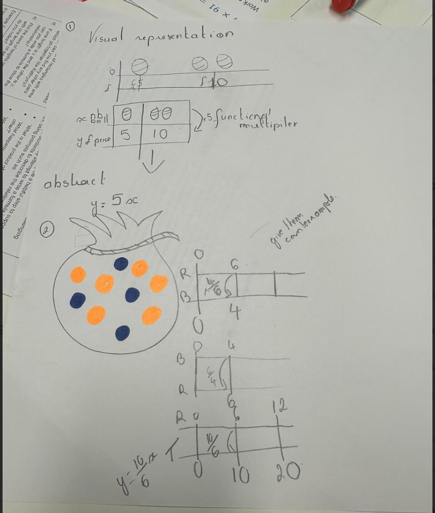
In our second session, we delved into the idea of mathematical thinking. This principle shifts the focus from passive learning to active engagement, where students are encouraged to not just receive information but to work with it, reason through it, and discuss it. Our work at the session looked at how visual representations can be used to support students in identifying patterns, making connections and embed long term-memory of the concept, displayed in the image below. 


A paper with writing on it

Description automatically generated


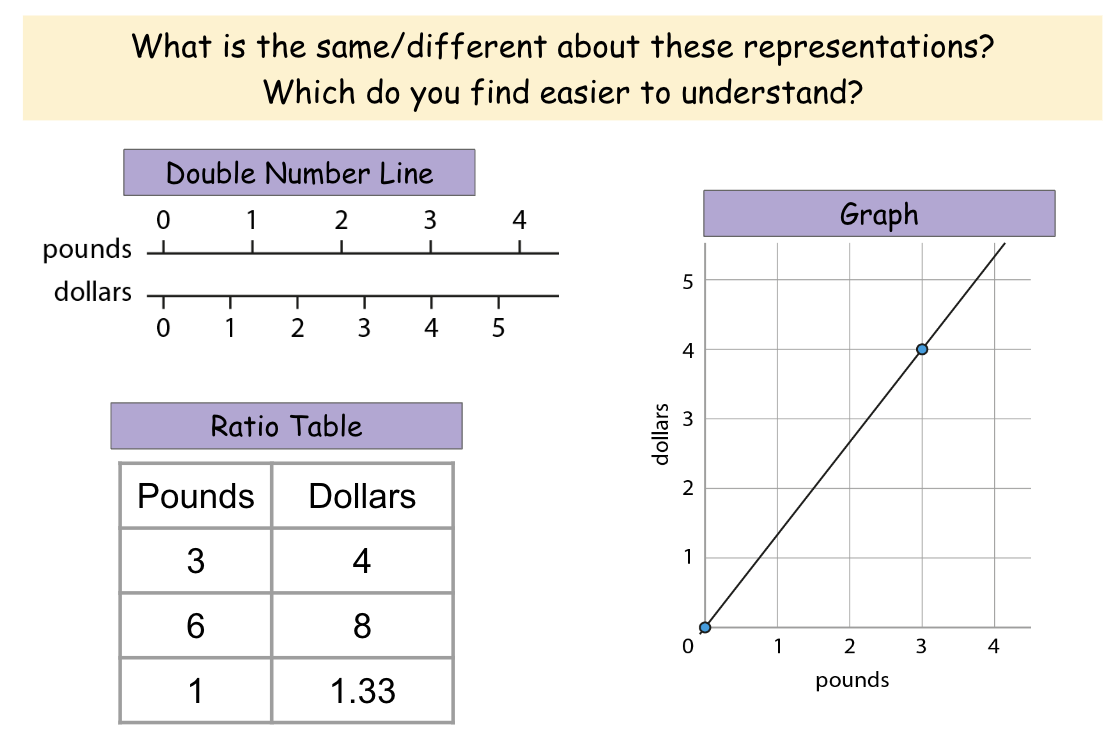
Following the session, Aditi and I facilitated an INSET session for all colleagues teaching Year 8, focusing on developing students' understanding of proportional relationships through multiple representations. We explored three key approaches to proportional reasoning: ratio tables, double number lines, and graphs. During the session, colleagues collaborated to examine the similarities and differences between these representations and identified key characteristics, such as the function multiplier and scalar multiplier, within each approach. The discussion also emphasized drawing connections not only between the representations themselves but also within different areas of mathematics.


This led to our second key takeaway: the power of using multiple representations to deepen understanding. Representations such as ratio tables, number lines, and graphs allow students to draw on their familiarity with concrete models while exploring the connections between different approaches. By linking these representations, students can develop a more comprehensive and interconnected understanding of mathematical concepts.


Application to Other Subjects
The principles of fluency and mathematical thinking, explored through this mastery CPD, are highly transferable across the curriculum. For instance, in English, fluency can be seen in developing students' ability to craft sentences that balance efficiency and nuance—moving beyond rigid structures to adapt language for specific contexts. By designing tasks that require students to rearrange sentences for emphasis or clarity, teachers can foster a flexible understanding of syntax and style, much like rearranging multiplication for efficiency in maths.


Similarly, multiple representations can be employed in science to deepen conceptual understanding. Consider teaching energy transfer: using diagrams, equations, and physical models side by side encourages students to connect theoretical principles with practical observations. These methods ensure students not only memorise facts but also develop the ability to reason and explain their ideas, creating a rich, interconnected understanding akin to exploring proportional reasoning with varied visual tools in mathematics. By extending these approaches beyond mathematics, we can enrich teaching practices across the curriculum, cultivating learners who are confident, flexible, and ready to tackle complex problems. 


Participating in the Teaching for Mastery Sustaining Workgroup has been incredibly beneficial. It has given us practical strategies that can be applied in the classroom to promote a deeper understanding of mathematics. We look forward to continuing this journey and sharing these practices across the department to ensure that teaching for mastery becomes a standard approach in our school. If you like to explore Teaching for Mastery and related workgroups, visit www.ncetm.org.uk.


Tuesday, 15 March 2022

Cross-Curricular Collaboration In Science & Maths

 By Jenny Scott

“...just like you do in maths!”


But is it just like they do in maths? In the science department recently we’ve become acutely aware of the importance of maths within science, and how we teach this to students. The Association for Science Education (ASE) published in 2016 “The Language of Mathematics in Science”, in which they identify ten different mathematical “‘kinds of things we do in science’:


  • Collecting data
  • Doing calculations and representing values
  • Choosing how to represent data
  • Drawing charts and graphs
  • Working with proportionality and ratio
  • Dealing with variability
  • Looking for relationships: line graphs
  • Looking for relationships: batches and scatter graphs
  • Scientific models and mathematical equations
  • Mathematics in the real world


Each and every one of these has links to the maths curriculum - we know that students are taught these things in maths, but we found that we didn’t know when or how they were taught them! 


To support our students in using their maths skills in science, we decided to launch a cross-department project to make our science and maths curricula more cohesive. This started with our KSCos and DoLs meeting to compare our curriculum mapping to simply identify when certain skills are taught in maths, and when those same skills are taught in science. This was eye-opening as we found that some skills which we were taking for granted in KS3 science (e.g. rearranging an algebraic equation) were not taught explicitly in maths until Year 9!


Our next step was to enlist the help of our whole departments in a joint department meeting to create a ‘STEM Dictionary’ in which we included common mathematical words and were able to discuss their definitions and uses in both maths and science. The maths department also modelled how they would teach certain skills. This was a really valuable experience as we were able to identify several areas of maths in science where we tend to approach it in a completely different way to the maths department - which must be confusing for students!


We are now in the process of adjusting our teaching of mathematical skills in science to reflect the methods used in maths (“equation triangles” are banished forever!), as well as the maths department working on including more science-based examples in their teaching. Overall - an ongoing but exciting project!

Thursday, 16 July 2020

Bitesize Research: How writing about classroom content impacts achievement

This week, I wanted to share with you a meta-analysis published by the Review of Educational Research in March 2020 by Graham, Kiuhara and MacKay.


Objectives of study: This review looked at how writing about classroom content impacted achievement in Maths, Science and Social Studies. Whether this varied from subject to subject, and whether age, assessment or writing activity type were influencing factors were also examined in this study. It used data from 56 studies, and around 6,000 pupils in years 2-12.


Headline findings: Writing about classroom content has a significantly positive impact on achievement in Maths, Science and Social Studies.


Summary of study: 

  • The ages of pupils did not impact the correlation between writing and achievement; it was strongly positive in all age groups.

  • The type of writing task (e.g. summarising a text, creating a narrative) did not impact the correlation between writing about classroom content and achievement.

  • The type of assessment in each subject also did not impact the correlation. 


How does this impact me and my practice?:

Some reflections questions arising from this that might be helpful to consider are:

  • How am I currently using writing tasks in my lessons? How impactful are they on student learning?

  • In what ways can I create written tasks that enable students to better learn classroom content?

  • How can I seek best practice with creating written tasks from subject areas such as English or Humanities?


If anyone would like to discuss this further with me - please start the discussion below!


Wednesday, 8 July 2020

IB Hub Day T&L Reflections 2020

WA has successfully held 4 inaugural subject specialist IB Hub Days this year. This has been a fantastic opportunity for our staff body to showcase their IB Approaches to Teaching and Learning, and also to create links with other IB schools and educational consultants and guru's in their subject areas. The agenda for the days have been of high quality, thought provoking and inspiring for those involved. A big thank you to all those who have been involved in organising the days - you are stars!

Below are the reflections from the English, Geography, History and Maths Hub Days and how the CPD from them have influenced these teachers' teaching and learning going forward.

English by Julian Gyll-Murray

T&L strategies learnt on the hub day: 

The most fascinating part of the day was the sessions delivered by two guest speakers- Susan Neilson and Gary Snapper. 


Susan spoke about how to develop student autonomy, and how crucial it is to guide students to approach texts in a self-sufficient manner. She emphasised the role of discussion and creative writing, the impact of modelling reading together as a class community, and the use of using student-led agendas in order to cover the themes of a text.


Gary delivered an inspiring session on approaches to teaching poetry in the IB. He recommended starting discussions on poems about the entire text before breaking them down, in order to develop a practice of forming a holistic understanding of the poem. He also showed creative ways of analysing the structure of poetry through exercises such as altering the order of stanzas, which gives the students a new perspective on the poet’s authorial choices.


How these strategies have been implemented in my/our practice:

As IB teachers, we adopted a number of Neilson’s strategies, such as letting students create an ‘agenda’ of what they would like to focus on in particular texts. Some of us have used the likes of Padlet to do this in lockdown to good effect. In the literature course, we have adopted much of Gary’s advice in order to approach the Unseen Poetry component of their Paper 1 exam. Here, good questioning was key, ensuring that students communicated their reaction to the text as a whole before thinking how the author elicited that reaction.


The impact so far:

Unfortunately, due to the lack of exams this year it has been difficult to measure the impact of these practices in concrete terms. However, it has definitely made IB English a more engaged and student-led experience for our cohorts, and has garnered a more enthusiastic and self-sufficient approach for many in the DP student community.


Geography by Grey Day

T&L strategies learnt on the hub day: 

I found the talk on ‘Thinking like a Geographer’ particularly interesting. As with most subject curriculars, the tendency is to stick with the required content and teach what is needed for the exams, however Karen Corfield introduced us to a number of resources that may not have been necessary for the IB curriculum, but would further broaden and strengthen our students’ knowledge of the wider world, allowing them to think more critically which would have a positive impact on their IB learning.


How these strategies have been implemented in my/our practice:

This could be implemented by creating reading/documentary lists for students to follow. Students could then complete reflections on what they had read/watched and link it with what they are currently learning at the time. Students could also complete mini research topics on current geographical events and affairs which may not necessarily be within the IB curriculum but would broaden their knowledge of the wider world and allow them to make links to what they are currently learning while also improving their critical thinking and research skills. 


History by Jodie Coller, Corinna Matlis & Charlotte Nicholas

T&L strategies learnt on the hub day: 

Our goal is to give students the kind of complex knowledge and arguments they need to succeed in IB history, and, following the IB Hub Day, it was clear to us that incorporating more historiography and more depth studies into our schemes of work will help us achieve this goal.  


How these strategies have been implemented in my/our practice:

Historiography: We incorporated historiography largely through two mechanisms. The first came back to IA technique. Through our discussions with other schools, it became clear that many history departments focus their students on a historiographical debate for their IAs. This is an excellent technique because it allows students to frame their own arguments through a comparison of historians’ arguments, and it forces students to evaluate carefully two different perspectives on an issue.  


We have also embraced historiography in our teaching of IB both through incorporating short snippets of historians’ work into most lessons, thereby showing our students that the topics we are studying are also debated by historians and that we want our students to join in the debate. 


Furthermore, we’ve begun to incorporate longer pieces of historiography into lessons by assigning academic articles as part of the required reading for students. We feel this is important as these articles not only introduce students to different perspectives on our topics but also act as models for students in how historians write and build arguments.  We have even started working this kind of task into activities for younger students from KS3 through activities like guided reading and using scholarship to answer enquiry questions.


Maths by Maria Prodromou

T&L strategies learnt on the hub day: 

On the agenda was a talk from Professor Karen Page on Voronoi Diagrams, a geometric construction new to the specification change this year. We saw a plethora of applications of a mathematical tool/construction to other subjects such as Biology (in nature and disease) and Geography (toxic waste dump problem). This gave us an opportunity to learn more about a piece of maths knowledge we have never taught nor ever applied! 


The problem solving session provided strategies to develop students’ inquiry skills. The wording of the questions were “unusual” in terms of standard Mathematics questioning - showing us how to create problems by purposely missing information that the students would need - can they realise what information is important to answering a problem? Some questions didn’t have a question and teachers were encouraged to write the hardest question they could think of, given the information - a task harder than it sounds!


The session on implementing the Toolkit gave an insight into how to use technology to enhance learning and create depth of understanding as the new syllabus has a strong focus on use of technology. Tom Holmes gave a phenomenal presentation on how to use geogebra to model real life contexts - a powerful tool to show the dynamism of maths, and limitations of a model.


How these strategies have been implemented in my/our practice:

It’s been great to take some of the examples Prof Karen Page spoke of and plan them into lessons on the Voronoi diagram and show students the cross-subject use of them - they love seeing maths in different contexts! It’ll be interesting to see if any student has been inspired by these wonderful constructions to ask a question to explore using them in their IAs. 


As Key Stage 5 Coordinator for maths the inquiry based questioning is something that we have been working on implementing in our new lesson planning for the new specification to create curious, problem solvers! It has also been great to plan lessons entirely dedicated to the toolkit with Geogebra, which the students have responded really well to as it’s something different to doing maths on paper.


Bitesize Research: The Relationship Between Students' Belief In Their Abilities And Their Achievement in Verbal And Mathematical Subjects

This week, I wanted to share with you a meta-analysis published by the Review of Educational Research in April 2020 by Moller et al. from the University of Kiel. 


Objectives of study: This review looked to synthesise 505 data sets on the relationship between students’ beliefs about their abilities (called ‘academic self-concept’) and their achievement in verbal and mathematical subjects. The review looks at three strands of academic self-concept; social (e.g. how good am I compared to others?), dimensional (e.g. how good am I at Maths compared to English?) and temporal (e.g. how good am I compared to how good I was?)


Headline findings: In terms of dimensional academic self-concept, as students develop positive self-concepts at one end of the verbal-mathematical continuum, they may develop negative self-concepts at the other end. 


Summary of study: 

  • Strengthening self-concept in Maths or Science leads to a weakening self-concept in reading and writing, and vice versa; students become ‘Maths’ or ‘English’ people. 

  • This does not align with the evidence of student achievement in those subjects; ability in verbal and mathematical subjects are not mutually exclusive and ability in both was positively correlated.

  • Dimensionally, talented students may develop only an average self-concept in their worst subject, even though their performance in this subject is above the average.

  • Particularly strong correlations were found between achievement and self-concepts with older students and where grades were given rather than standardised test scores.


How does this impact me and my practice?:

Some reflections questions arising from this that might be helpful to consider are:

  • In what ways can we avoid binary self-concepts in students and avoid them thinking they are either ‘Maths’ or ‘English’ people?

  • How does this research link and strengthen the case we can make to students around taking and flourishing under the IB?

  • How can we ensure that our students maintain a high level of academic self-concept? 


If anyone would like to discuss this further start the discussion below! I’d be delighted to open up these discussions and conversations.