Showing posts with label Oracy. Show all posts

Saturday, 7 February 2026

The case for choral repetition in all subject areas

By Jemma Holden

In MFL, a lot of our time is spent drilling vocabulary - repeating new words and phrases until they stick. This can feel a little mechanical, and it’s not always obvious if students are actually remembering anything. However, I’ve found that choral repetition - asking a whole class to repeat key words in unison - can really help students engage and retain what they’ve learned.

A key benefit of choral repetition is that it encourages a culture of ‘no opt out’. Every student needs to be engaged and listening, every student is expected to attempt an answer, and every student has the chance to learn. It stops us assuming that silence equals understanding and prevents the confident few from taking control. Research shows that actively producing information, rather than just hearing it, strengthens memory and helps students retain knowledge more effectively. It also supports confidence and resilience as students quickly learn that making mistakes out loud is part of learning, and it gives teachers the chance to address whole class misconceptions efficiently.

However, I am definitely aware that achieving 100% participation isn’t always easy, and I’ve had many lessons met with awkward silence and have wondered if a class would ever join in. But I’ve found that with clear routines and consistently high expectations, most students eventually meet you there.

Routines make a real difference. In my Spanish lessons, I use simple cues: Escucha (hand to my ear) and Repite (pointing to the students). This signals exactly when students should respond and helps keep lessons moving. The consistency also helps students feel safe to try, even if they might get it wrong. Over time, most students begin to speak more confidently

Additionally, I’ve found it helpful to encourage engagement with plenty of praise. I regularly award house points to recognise strong effort and good pronunciation or recall. For younger years, turning it into a competition also works well. For example, splitting the class in half and awarding points to the half with stronger pronunciation, pace or effort. Over time, participation becomes more automatic, even when the vocabulary is new or challenging.

While call and response lends itself particularly well to languages, it’s a technique that can work across all subjects. I did a placement at an Ark Academy school last year, and saw it effectively used across the board, with really positive impact. For example, in English, the teacher asked, “Who killed Macbeth?”, counted down, 3, 2, 1… and the whole class answered together. In science, students chorused definitions of key terms in the same way. The energy in the classroom was noticeable, and every student was actively thinking and participating.

When used consistently, call and response helps to keep students actively involved, gives teachers immediate insight into understanding, and turns repetition into a purposeful part of learning rather than a passive routine. Try this out!

Further resources:

https://tipsforteachers.co.uk/call-and-respond/ 

https://www.innerdrive.co.uk/blog/choral-response/ 

Doug Lemov, ‘Teach Like a Champion’, Chapter 4: Engaging Students in Your Lesson


Tuesday, 11 February 2025

Classroom Oracy: The Key to Unlocking Potential

By Najiyah Rahman

Analytical questions plague all aspects of the English Curriculum and students are required from time to time to show this skill, but are they engaged in doing so? This last term I set out to change my practice as I had identified a key concern in my Year 11 class, which is a lack of fluency in analytical writing. My students know the basics of writing and have knowledge of the text but are not incorporating this knowledge in their writing consistently. My results from Inquiry 1 show that students prefer classroom oracy as a method of engagement.  It was also identified that they find structuring their answers difficult. 


In this inquiry, I will discuss how removing PEEL/PEE writing frameworks for paragraph writing in exchange for thinking frameworks like WHAT HOW WHY allowed my students to better structure their work and discussions. I aim to understand the correlation between using an optimal engagement tool (as identified via student voice) and improved performance in analytical writing tasks.


What did I do?
I had introduced debate and discussion lessons based on an exam question. We followed this format for other lessons leading up to the exam however below is an example: I wanted to hone in on Shakespeare’s purpose as a lot of their analytical paragraphs lacked in this area. They were able to make points and provide evidence but not explain why these choices were made. The aim of this task was to equip them with several different reasons as to why Shakespeare made particular choices. 
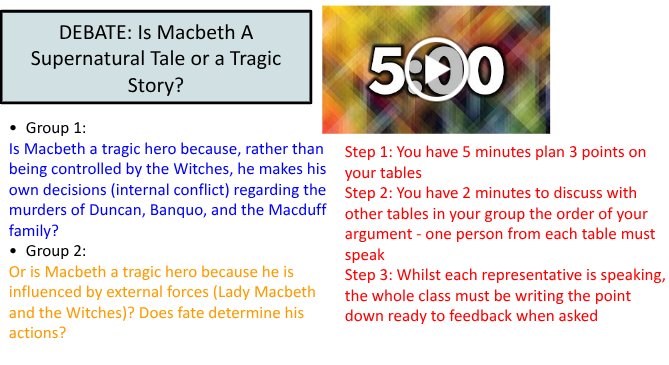
Students had 5 minutes to plan in groups on their tables. They needed to make three points. The way I had guided their discussions was through the WHAT HOW WHY thinking frameworks which I made explicit on the slide below. I made it clear that the screen was there for support but they could use the framework to shape their thoughts individually. 
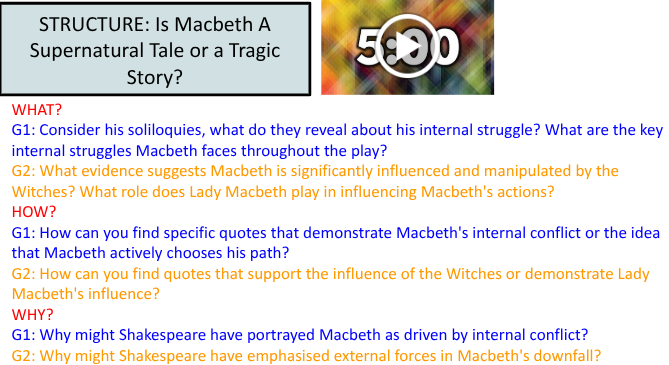


Group 1 and Group 2 had three tables each. After the 5 minutes were up, they had 2 minutes to discuss their answers with the other two other tables and find the strongest point that each of them would argue. 


When the debate started, all students had to write notes from each point each table discussed. At the end of the discussion, students were given 3 minutes to order their 6 points and answer the debate questions. 
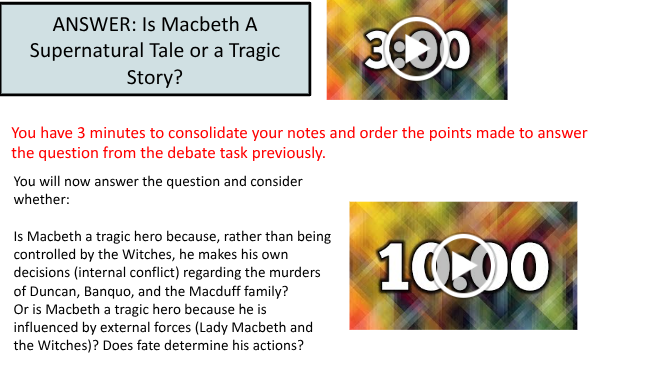

After they had written their responses, a student asked “This isn’t an exam question, how do we apply this to the exam?” to which I had responded, “You all identified that debates and discussion engages you the most, all of you identified you found structure difficult and all of you were unable to explain your points in detail. This task has allowed you to use a new thinking framework to answer any question, it has also provided you with 6 different points about Shakespeare’s purpose which you can apply to EVERY question!


How did I measure it?

I measured feedback via student voice, pre-existing and new mock data and observations to triangulate my data.


  1. My primary source of data came from the mocks comparing what they achieved in the autumn pre-mocks and the winter mocks. Here is the table below:

Grades

Autumn Mocks

Winter Mocks

Below 4

52% 

43%

9-4

48% 

57%

9-5

39% 

39%

9-7

26% 

22%

The table shows the distribution of grades in Autumn and Winter Mocks. Here's a comparison:


  • Below 4: The percentage of students scoring below 4 decreased from 52% in Autumn Mocks to 43% in Winter Mocks. This indicates an improvement in overall performance.

  • 9-4: The percentage of students achieving grades 9-4 increased from 48% in Autumn Mocks to 57% in Winter Mocks. This suggests a significant improvement in the higher-achieving band.
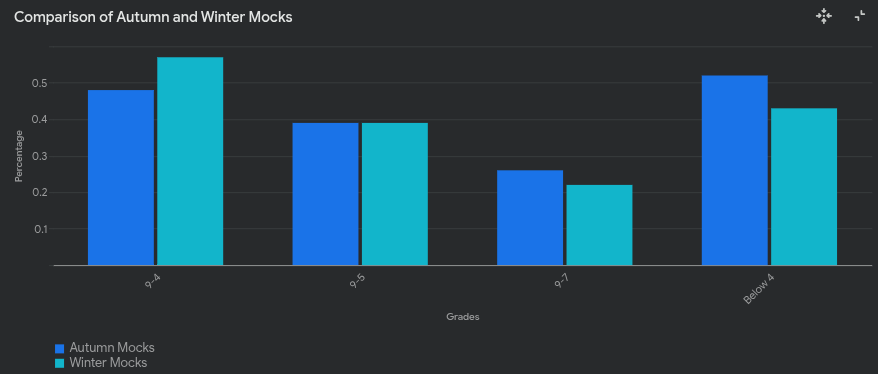
  • 9-5: The percentage of students scoring 9-5 remained consistent at 39% in both Autumn and Winter Mocks. This suggests that the proportion of students in this range remained relatively stable.

  • 9-7: The percentage of students achieving grades 9-7 decreased from 26% in Autumn Mocks to 22% in Winter Mocks. This might indicate a slight decline in the top-performing group.


Overall, the data suggests a positive trend with a decrease in the percentage of students scoring below 4 and an increase in the percentage of students achieving grades 9-4. 


However, a slight decline is observed in the top-performing group (9-7). This may have been due to external factors such as revision and time-management (which a lot of them had informed me of after their exams). 


  1. My second piece of data collection was through observations. I had seen a significant improvement in engagement, comments like “Miss, that was a fun lesson!” and “I’ve learnt a lot today!” and all students were able to write significantly more than what they previously were able to do. 


I am awaiting books to photograph evidence of this*


  1. And my third piece of data, I am still awaiting student feedback via survey. 


Below are the questions from the survey:
Student Survey: Impact of Debates/Discussion on Analytical Writing


How engaged did you find yourself during these discussions/debates?

a) Not at all engaged

b) Slightly engaged

c) Moderately engaged

d) Very engaged


To what extent do you believe participating in discussions/debates helped you to: Understand the different perspectives on the topic?

1 (Strongly Disagree) - 2 - 3 - 4 - 5 (Strongly Agree)


To what extent do you believe participating in discussions/debates helped you to:
Develop your own arguments?

1 (Strongly Disagree) - 2 - 3 - 4 - 5 (Strongly Agree)


To what extent do you believe participating in discussions/debates helped you to:
Identify and analyse evidence to support your arguments?

1 (Strongly Disagree) - 2 - 3 - 4 - 5 (Strongly Agree)


To what extent do you believe using the WHAT HOW WHY thinking framework helped you to: Structure your written responses to analytical questions?

1 (Strongly Disagree) - 2 - 3 - 4 - 5 (Strongly Agree)


To what extent do you believe participating in discussions/debates helped you to:
Improve your use of language and vocabulary in your writing?

1 (Strongly Disagree) - 2 - 3 - 4 - 5 (Strongly Agree)


Overall, how helpful do you think class discussions/debates and thinking frameworks were in preparing you for writing analytical essays?

a) Not helpful at all

b) Slightly helpful

c) Moderately helpful

d) Very helpful


Do you have any other comments or suggestions regarding the use of debates in class?

(Provide space for open-ended written responses)


So what were the challenges?  

There were many challenges I had encountered: 


  1. Maintaining Focus: While the initial enthusiasm for debates was high, sustaining student engagement proved to be a challenge after a while. Some students, particularly those less confident in their speaking abilities, tended to disengage or become passive listeners.

  2. Differentiation: Ensuring all students, regardless of their confidence levels, had an equal opportunity to participate and contribute to the debates was challenging. Some students dominated the discussions, while others remained silent and it was hard to force them to talk.

  3. Activity Time Management: Incorporating frequent discussion into the lesson required careful planning and time management as often I had found we ran out of time to get to writing.

  4. Assessing Participation: Accurately assessing individual student contributions within the dynamic context of a debate presented a challenge.

  5. Revision:  While the debates improved student understanding of the text and helped them generate ideas, some students still struggled with effectively revising the scheme of work/what they had learnt about the text prior/forgot key moments of the text etc.

  6. Individual Time Management: Students still had difficulties with time management during the writing process and being able to finish an answer within the allotted time. 


What are my key takeaways?

My 5 key takeaways from this inquiry were: 


  1. The positive impact of classroom oracy: The initial data analysis suggests that classroom debates, when effectively implemented, can significantly enhance student engagement and improve performance in analytical writing tasks.


  1. The importance of scaffolding and support: Providing clear structures, such as thinking frameworks (WHAT? HOW? WHY?), and explicit guidance can help students navigate the debate process and maximise their learning.


  1. The need for ongoing evaluation and adjustment: I need to continue to refine my approach to classroom debates, addressing the challenges identified and exploring new strategies to enhance student participation and learning.


  1. The importance of addressing individual needs: I need to implement strategies to ensure all students have an equal opportunity to participate and contribute to the debates, such as peer-to-peer support and differentiated questioning techniques.


  1. The need for continued focus on revision strategies: I will need to provide more explicit instruction and support for students in the revision process, including strategies for time management and effective use of feedback.


Thank you for taking the time to read my blogpost! Feel free to share your comments and thoughts at n.rahman@westminsteracademy.org.uk

Tuesday, 15 November 2022

Bitesize Research: Impact Of Hand Gestures On Oracy & Retrieval

 By Jaya Carrier

I hope you’re all having a good week so far. As part of our ongoing thinking about oracy, this week I was interested to come across some ideas about the power of using hand gestures in the classroom.


Objectives: To consider the impact of hand gestures on oracy, clarity and retrieval, both by teachers and students.


Summary: 

  • There is a large body of research that suggests using gestures are essential in the formulation of oral responses. 

  • It has been shown that the greater the cognitive strain or the more challenging a conversation is, the more gesturing takes place. 

  • Further research has suggested that encouraging gesticulating frees up cognitive space, and therefore it enables students to be both more creative and more fluent when producing oral and written responses.

  • A 2011 meta-study suggested that students understand more of what teachers say when hand movements accompany words

  • Students are also more likely to remember and retrieve things if they use hand gestures at the point of initial encoding or first encountering a piece of information. These gestures should be deliberate rather than spontaneous. 

  • The article suggests the following key takeaways:


  1. Teachers should practice deliberate gestures before lessons particular when considering their teacher expositions, e.g. using their fingers to count the order of the planets

  2. Teachers can direct students to watch their hands when they are explaining something new, as it encourages better retrieval

  3. Teachers should encourage students to use gestures when doing talk activities in their classroom

  4. Teachers can encourage students to use their hands if they are struggling to recall a key piece of information or keyword e.g. ‘How about moving your hands to find the right words?’

  5. Students can be directed to recreate the gestures of their teachers as a way of recalling key information

  6. Teachers can direct students to use what are known as deictic gestures - e.g. tracing a map, or geometry figures, or pointing to an anatomical label


How does this impact me and my practice?: Some reflections arising from this that might be helpful to consider are: 


  • How do I use gestures currently in my lessons? 

  • How can I explore my own use of gesture, as well as encourage students to use it too?

  • When I have someone observe me, or I am observing a colleague, what gestures are used? What impact do they have?

  • Which of the key takeaways would I be interested to explore?

Tuesday, 25 January 2022

CPD Reflections: Classroom Talk

By Will Glydon

What got me thinking about this topic? Classroom talk can be tricky! It can be difficult to ensure that all students are fully participating in pair and group work as some students find it difficult to share ideas and are overpowered in conversation by their more extroverted classmates. As well as this, comfort with class talk can certainly vary depending on the stage of your career. As an early career teacher, I know that maintaining solid behavior management can cause teachers to steer clear of group work activities as it can feel risky to let go of complete control. Where did I find some research on this topic? Researchers Doug Lemov and Martin Robinson answer questions on Classroom Talk in 'What does this look like in the classroom?' by Carl Hendrick and Robin Macpherson. I have selected three questions, which the researchers responded to, that particularly piqued my interest as I felt they were applicable to WA. I also looked at the Bitesize Research from last week which had some of the School 21 oracy strategies. Below are some responses that pick out tactics and techniques to tackle Classroom Talk.

How can I make sure that classroom discussion is rich rather than superficial?
I picked out this question as I personally find this difficult. I find that sometimes students are talking without offering much substance or deep thought. The researchers Doug and Martin offer these pieces of advice:
  • Writing the key question on the board and leaving it there is an easy way to keep the topic on track
  • Think of the extent to which you are valorising ‘outside the box’ comments by saying things like “Oh, that’s so outside the box!” It is important to encourage different ways of thinking, but to generate rich, rather than superficial discussion, what teachers should be aiming for is to generate very insightful ‘inside the box’ comments. They argue that explicitly explaining this to students is important.
  • ‘Meta feedback’ is important for students who go off-topic. Language that can be used can be something like “she made an excellent point, let's respond to that first before we move onto a new topic”
  • ‘Charting it’ is the final technique mentioned. This involves writing the ‘golden nuggets’ of the conversation on the board to refer back to throughout the lesson. This is not only praising rich and insightful comments made, but as we all have working memory overload and forget conversations quickly, it means the comment will not be forgotten.
Another technique that was mentioned in the School 21 blog post last week is having ‘Talk Detectives’. This involves choosing students to walk around the class, listening to conversations, and monitoring the level of discussion. This could be a great way to encourage the students to think carefully about the richness of conversation whilst in group work. How do you ensure that all students contribute in pair activities, small and larger group work? I have noticed that some of our students are much quieter learners, however, it is still important to encourage these students to fully participate in classroom talk activities. Some of the strategies that the researchers Doug and Martin share are as follows:
  • It is important to ensure that students are writing something before they go into their groups. That means their conversation will be Version 2.0 of their thinking and give them more confidence to share their ideas instead of feeling rushed and panicked. This technique also encourages deeper thought.
  • For pair activities, a good technique is to ‘manage turns’. This is achieved through the teacher instructing the person on the left to speak for 30 seconds and share their ideas first, then the right. This allows both students to have equal time in sharing ideas.
  • For group work, teachers should be giving ‘Meta feedback’. This involves giving large groups feedback on their ability to speak and listen to others and not dominate the activity. The skill of listening should be praised.
  • It is important for students to get into “Habits of discussion”- These habits can be achieved through providing sentence frames for the students to follow. Maybe these habits will be too prescriptive for KS4, but they could be beneficial for KS3 to build listening and speaking skills?
How can I get pupils who are used to talking informally (i.e. in slang) to be able to adopt the register required for success in exams and beyond? I chose this question as I have noticed that some of our students can have incredible thinking and brilliant points, but sometimes it is not articulated in quite the right way. The researchers suggest:
  • Consistently make a point to upgrade student language. This can be done through responding with something like “good point, but now put that same point into the language of a geographer”
  • Putting technical tier three vocabulary on the wall of a classroom can help. This way, students can refer back to it and the teacher can point to the vocabulary to assist them.
  • It is important to make a point of the fact that the students don’t need to have classroom talk in the same way that they write in an exam. However, it is important to explicitly say that there needs to be a formal level to classroom discussions, it should not be ‘playground talk’. This will encourage students to think more about what they are saying.
I hope that you find some of this research useful and there are a few ideas that you might find useful to use in your own practice. If anyone would like to talk about some of these ideas any further, then drop me an email and we can arrange a time to meet up to have a further discussion. Likewise, if anyone tries some of these techniques or any other to develop classroom talk, then let me know your findings!

Monday, 10 January 2022

Bitesize Research: Classroom Talk & Oracy

By Jaya Carrier

I hope everyone’s having a great week so far! This week, following our student-centered blog theme for T3, I was really interested in a piece on Edutopia about classroom talk that showcases some of the School 21 oracy strategies. Objectives: To outline some of the strategies from School 21’s acclaimed work on classroom talk and oracy. Summary:
Some of the strategies highlighted include -
  • Create discussion guidelines. These include: always respect each other’s ideas, and be prepared to change your mind.
  • Use ‘talk detectives’. These are students that circulate whilst group or pair discussions are taking place with a copy of the discussion guidelines. Then they write down the names of students who evidenced the guidelines you’ve set, and what it is that they said. This supports developing metacognition around oracy.
  • Consider carefully the groupings of your students. This is both in terms of the students themselves but also the different types of positions they are in.
  • Model and clarify what good listening looks like. Be explicit about asking students to demonstrate good listening behaviours which could include looking your partner in the eye, considering their talking volume and giving their partner personal space.
  • Create discussion roles. These include: instigator, builder and summariser. One strategy used by School 21 is that they film staff having conversations in these roles and students use these videos to identify the roles being taken.
  • Create structured talk tasks including controversial ‘talk point’ statements, ‘ghost reading’ and ‘collective writing’.
  • Build up confidence in shy students by giving them talking sentence starters.
How does this impact me and my practice?:
Some reflection questions arising from this that might be helpful to consider are:
  • What is important to me about oracy and student talk in my lessons and in my subject?
  • How does oracy and student talk benefit student learning in my subject?
  • How am I already integrating student talk into my lessons? How successful has it been? How do I know?
  • Which of these strategies could be helpful in a lesson I’m planning to teach in the near future?
If you would like to discuss this further with me - please let me know! I’d be delighted to open up these discussions and conversations.

Wednesday, 8 September 2021

How To Get Students Talking

 By Ruhina Cockar

How do I get my students to talk?! This may sound like a strange question when so often we’re thinking about how to positively encourage students to stop talking and focus on their work! Talking and discussion offer invaluable learning opportunities for teaching the curriculum as well as for the development of the “global citizens” we aspire for our students to be. Let’s say, for example, you want to have a whole-class discussion on a topic like “Bullying or banter? What is and what isn’t acceptable” or you want students to discuss one-to-one with each other about domestic abuse and its effects on the family unit- can these topics be explored effectively if students don’t talk? In general, students are more likely to discuss and participate freely if they feel comfortable in their environment and trust that their contributions are valued- so how could you achieve this? Fail to prepare, prepare to fail holds true when facilitating a discussion: having an idea of what the journey of the discussion will be from start to finish, and the questions you might ask to ensure the discussion stays on track will maintain the flow and ensures there is an objective to it; free-flowing discussion with no purpose or direction leads to off-task behaviour and erodes trust. Establishing the ground rules before the discussion takes place will help build trust: it might be helpful to refer back to your Partnership Agreement (or to create one if you haven’t got one established in your classroom) and remind students of what everyone has agreed to in terms of how to speak to and how to treat one another. Clearly communicating the purpose of the discussion, whether you will do hands-down questioning or not, whether this is a pose, pause, pounce, bounce type of discussion will also work towards creating a comfortable environment for students to be open: they understand theirs and their peers’ boundaries. If you choose not to use hands down questioning, an alternative approach would be to use a token system: Distribute three tokens to each student at the beginning of the discussion. Each time a student speaks, a token is given to the teacher. The goal is for students to spend all their tokens by the end of the discussion. This system can be really useful in limiting students who dominate the discussion and encouraging quiet students to contribute. A technique for ensuring quality discussions take place is one built on thinking time. Posing the question for discussion and asking students to work in pairs or as a group to write down their initial thoughts, answers or ideas will help ensure the class discussion is meaningful and productive as students have had a chance to think about the issue beforehand. Learning things about your students, asking them about their interests, acknowledging their answers through writing the comments on the board and/or making connections between their comments and the discussion at large will start to help students feel comfortable and valued. Examples of comments that acknowledge a student:

  • That’s an excellent point Lara.
  • I like that you’ve given the other point of view Ahmed - it shows balance and many of us would not have considered that perspective.
  • Aya it was brave of you to share such a personal experience - thank you.
  • I think you may have misunderstood the question Borislav but I appreciate your contribution and willingness to speak.
  • As Samiya said earlier…
A further question to consider about seating arrangements: could everyone sit in a circle? Around a table? Would you like the person speaking to stand and make their point? Seeing each other facilitates listening, and acknowledging each other.

With a nod to life skills and careers we know communication and working collaboratively is an essential skill, whether this is in a group work setting or in a discussion setting - it’s imperative students feel confident in their ability to articulate their thoughts and ideas so they are heard.

I hope this post goes some way to helping you teach our students this and please share any ideas, suggestions and experiences you may have in the comments below