Showing posts with label Marking and Feedback. Show all posts

Tuesday, 31 January 2023

Bitesize Research: Learning From Assessments

 By Jaya Carrier

I hope you’re all having a good week so far. As we start to think about processes of exam feedback and review and improve for YR11, I was interested to read the following Edutopia article on assessment.


Objectives: To provide effective three strategies for learning from assessments


Summary: 

  • Tests offer insights into both students’ content mastery and study skills.

  • The author suggests doing a ‘test replay’ as part of the post-exam debrief in order to gain insights into both of these two areas.

  • The author recommends three things as part of this ‘test replay’:

    • 1) An instant ‘brain dump’ after the test whereby students capture the questions and any surprises from the test. Some guiding questions for this might include; ‘What was I well prepared for?’ and ‘How did this test compare with my expectations?’

    • 2) A ‘slow-motion replay’ whereby when students get their tests back, they have a deeper probe of their thinking and studying. Questions you could ask students at this point include; ‘What clues are built into the test question?’ and ‘What strategies did you use to make sure you understood the prompt?’

    • 3) Encourage students to think about their preparation for future exams in light of the one they’ve just received back. This supports building metacognitive skills. 


How does this impact me and my practice?: Some reflections arising from this that might be helpful to consider are: 


  • When am I next doing test feedback?

  • What elements of the ‘test replay’ am I doing already? What could I improve or sharpen?

  • What support do I need for this?


Please do get in touch if you would like to talk further about this - I’d love to hear from you!


Tuesday, 29 June 2021

What Is The Impact Of SLA Marking On Student Attainment In Science?

As part of the Extending Influence and Impacting Others module of the PGDE via Teachfirst, second year trainees have to carry out an action-research-style project on an area of their choosing. This is Jenny's summary of the evaluation she has carried out in Science over the past two terms.

By Jennifer Scott

In my final module for my PGDE, I recently investigated the research question: What is the impact of detailed SLA marking on students’ attainment in science? Here I will outline the investigation, in the hope of sparking some discussions around marking across the school! Motivation: My main motivation for this investigation was that day-to-day discussions with other teachers suggested that our written feedback in Science was not having the impact that it ‘should’. Therefore, I wanted to investigate whether the approach to SLA marking we were using in Science could be improved. Literature summary (in brief): The EEF has a wide-ranging Marking Review including several suggestions. Some which we have already embedded into the marking policy itself are: to provide specific, actionable feedback; and to allow students time in lessons to respond. There is also a word of caution: if students are producing “superficial responses” then the impact of marking is likely to be smaller. A lack of motivation appears to be a significant factor in whether students respond in sufficient depth to their actions One potential cause of this could be their mindset: as described by Dweck (2006) (as well as on the poster in every classroom!), students with a ‘fixed mindset’ are less likely to believe that they can improve their ability, whereas students with a ‘growth mindset’ believe that they can improve with effort and practice, and thus are more likely to make the most of SLA feedback. Also, Henderson and Harper (2009) noted that whilst teachers generally viewed assessments as formative, students viewed them as summative, and therefore were less motivated to improve their knowledge on a given subject after the assessment. A suggestion from the EEF which we have not yet embedded is to distinguish between “mistakes” (caused by carelessness) and “errors” (caused by lack of understanding).


Methodology and Results: Part 1: Surveys to collect teacher and student views All Science teachers completed a survey on their views of science SLA marking, as did 83 Year 9 students. The results bore out five key messages about our current SLA marking: A high proportion of students do not complete their SLA responses fully; More than 80% of students feel they understand the purpose of SLA feedback (despite only 50% of teachers thinking they did!), but they tend to frame it negatively e.g. “to see what we got wrong” (as opposed to “to see how to improve” etc.). This provides some evidence of a lack of student ‘growth mindset’;

  • Consistency in marking methods is present between teachers, but teachers are not sure if these methods have a positive impact on students;
  • Teacher workload: if the feedback is not having a positive impact on students, time spent marking feels wasted.
  • Accessibility of actions: teachers felt that content often needed to be retaught in order for students to respond to actions, while students equally felt that if they did not know the answer in the test, they still would not know the answer for the SLA. Some teachers have already been working to improve this by providing students with specific resources to use when completing their actions.
All these points served to reinforce my motivation and informed some trial changes made in part 2. Part 2: Comparing a ‘normal’ SLA, no SLA, and a new SLA I chose to carry out this investigation with my two Year 9 classes in parallel. After a regular end-of-topic test, each class received feedback before being given a ‘retest’. This took place in two stages (at the end of two consecutive topics). 9Z4 were the ‘control’ group, completing the usual style of SLA after going through a few ‘frequently missed’ questions with the class, before completing the retest the following day. They did the same process in both stages. This consists of a Strength I identify, a specific Literacy target, and 2-3 specific Actions, which are usually questions or tasks which ask students to consolidate upon or expand upon areas of misconception I had picked up from the marking. 9X4, on the other hand, did not complete an SLA in stage 1: they only went through frequently missed questions as a class, before immediately completing the retest. In the second stage, 9X4 completed an SLA with some trial changes, before completing the retest the following day. Neither class was given much warning of the retest, to increase the likelihood that any improvement was due to the feedback and not extra study! The main change in the updated version of the SLA involved students completing a ‘review table’ of all questions, noting why they lost marks and giving an explanation/correction (example seen below). This is strongly weighted towards student metacognition rather than personalised teacher feedback. I tried to incorporate a teacher-directed action as well, but it felt like too many different tasks for students to complete within the SLA lesson. The surprising results of the two stages can be seen below: there was no statistically significant difference in the percentage of students improving their score, regardless of whether they had completed the SLA or just gone through some questions (stage 1). It should also be noted that the average percentage score improvement was roughly the same at ~13%. Equally in stage 2, there was no significant difference in percentage of students improving between the current and updated SLA methods. This could be for various reasons, not detailed here for brevity.

Conclusions and looking forward: Overall, it can be said that the current SLA marking in the science department ‘works’ (for most students; in the short term), in that it does allow students to improve their knowledge on the given topic. However, it does not give a significantly different improvement in students’ attainment than simply going through the most frequently missed test questions with the class. This raises the following questions:

  • How can we ensure that students engage fully with marking?
  • How can we frame end-of-topic tests more formatively, so that students are more likely to see the importance of working to improve on them?
  • What is the best approach to marking end-of-topic tests to ensure they have maximum impact on student learning?
I would be very interested to hear others’ views on the questions posed here, how they apply within their own subjects and any suggestions in response (I have a few of my own)!

References:

EEF (2016) A marked improvement? Education Endowment Foundation. Available at: https://educationendowmentfoundation.org.uk/public/files/Presentations/Publications/EEF_Marking_Review_April_2016.pdf.

Dweck, C. (2017) Mindset - Updated Edition: Changing The Way You Think To Fulfil Your Potential. Hachette UK. Available at: https://play.google.com/store/books/details?id=ckoKDQAAQBAJ.

Henderson, C. and Harper, K. A. (2009) ‘Quiz Corrections: Improving Learning by Encouraging Students to Reflect on Their Mistakes’, Physics Teacher, 47(9), pp. 581–586. doi: 10.1119/1.3264589.


Tuesday, 5 January 2021

Rubrics: A Guide

By Divisha Patel

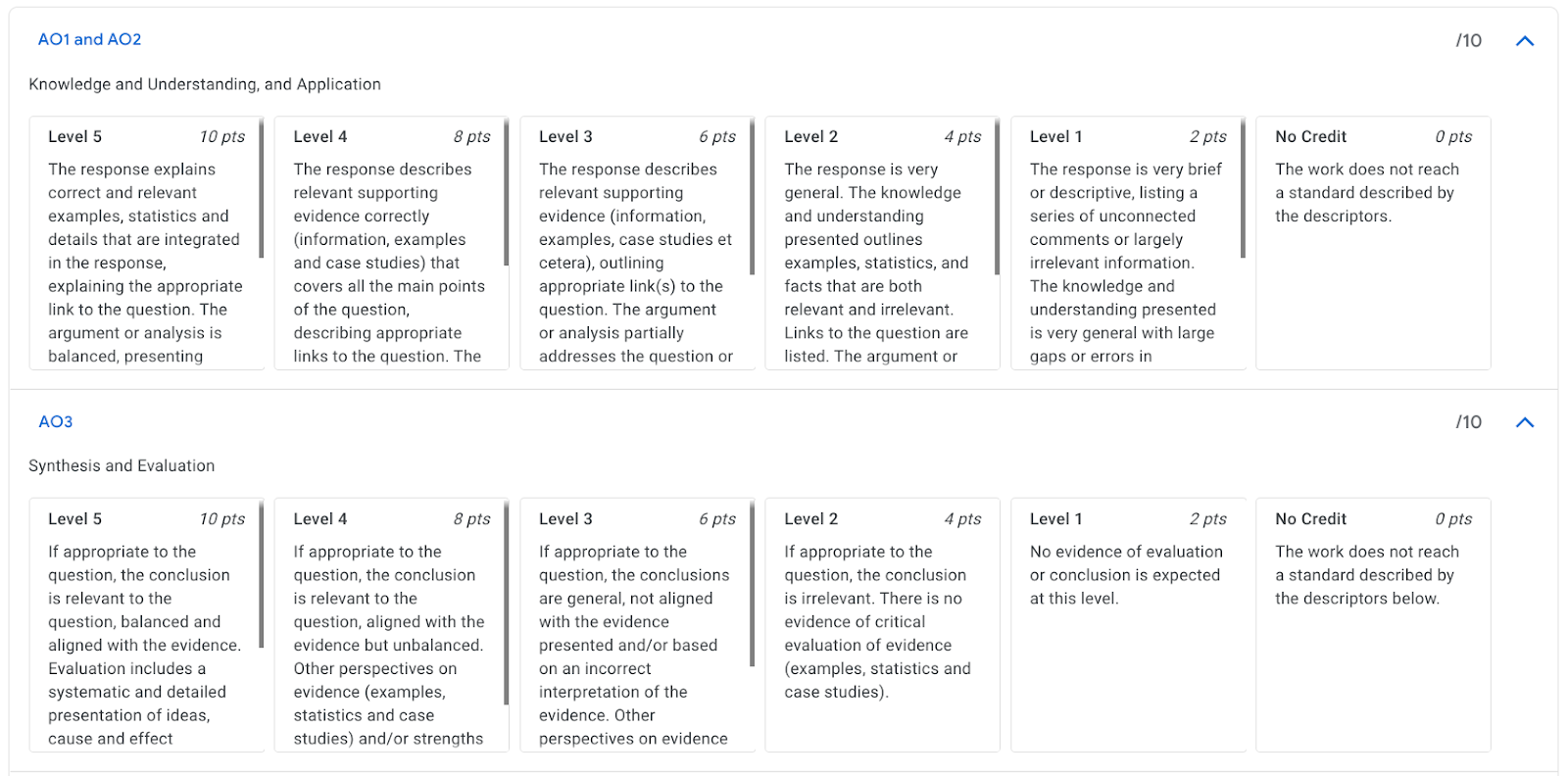
One of the great features of Google Classroom is ‘Rubrics’. Teachers can create, reuse and grade student work using rubrics for individual assignments. Rubrics are essentially mark schemes that can be added to your assignments, but can also be used by students as a success criteria. Rubrics can easily be shared between other teachers to avoid replication. 

Below is an example of a rubric used for providing feedback for IB extended answers in Geography. Each criterion relates to the assessment objectives, and provides clear guidance on how to achieve each level. 


The above rubrics has a score assigned, but the rubric can be adapted to be unscored. This may be used for grading effort or SPaG. 


The following video outlines:

  • How to make a rubric

  • How to assess work using a rubric

  • How to share your rubric with other teachers


For a demonstration of the above the video here will help:


For further information about how to use Rubrics, visit the Google for Education support page here. 

Using rubrics on Google Classroom 


Monday, 28 September 2020

Pride in Books

How do you encourage students to ensure their books are kept with a high level of pride, when it has been publicly acknowledged that they won't be marked?


This week the leadership team were asked this great question as a way of ensuring high standards are continued into the covid-restricted classroom.


Most of the ideas discussed were around getting buy-in from students as to why it’s important to lay their work in their books properly: it shows progress, it shows the high expectations of themselves in terms of pride in their learning. 


Teachers can show examples of books with a logical, easy-to-follow layout and discuss what they’ve done to make their notes clearly tangible. This is an opportunity to showcase examples where students have less “neat” handwriting, so that we can emphasise this isn’t a question of pure aesthetics but making books a useful tool for organising learning.


If students can buy-in to the idea of their books being a clear and well organised revision resource that they can use for day-to-day recall or bigger summative exams they will start to maintain their own high expectations of their books. 


If you would like to still show students you are still looking at their books, an idea posed by one leader was to ask students to hold their books up in a lesson and do a scan of them from the front - it’ll be easy to tell whose book is looking a little scruffy!


A great idea posed by another leader would be to involve showing the books to parents at Progress Review Day meetings and/or parents and using the time to get parental buy-in too. 


If you have any other ideas we’ve missed in the discussion please do comment with it below; we’d love to hear from you and what you’re trying in the classroom!


Saturday, 12 September 2020

Bitesize Research: The Impact of Feedback on Student Progress

Feedback, Confirming, Balloons, Clouds

I hope everyone is well. I wanted to share with you a study published by the British Journal of Educational Psychology in February 2019 by Skipper and Douglas.  


Objectives of study: Historically, lots of research has been conducted to show the impact of feedback on student progress. However, this study looked at the unchartered area of how teachers choose to deliver feedback, and whether they choose to deliver feedback based on student ability or on student effort. This study was conducted with 169 teachers, whereby the teachers were given 6 scenarios to read, each describing a lesson where the teacher asked a particular student to complete a task. In three of the scenarios, the student succeeded, while in the other three, the student failed. After reading each scenario, teachers were asked to rate their perception of task difficulty, the likelihood of giving feedback and the likelihood of giving feedback based on student ability or student effort. Teachers were also asked to complete a survey measuring the extent to which they believed student abilities and intelligence are fixed. 


Summary of findings: 

  • Teachers were more likely to provide feedback following success than failure

  • Following students’ failure, teachers were more likely to provide feedback based on student effort rather than on student ability 

  • When the tasks were perceived to be challenging, teachers were more likely to provide feedback

  • Teachers who believed more in the view that intelligence was fixed reported that they would give both more praise based on student effort and ability, but following failure gave more effort feedback

How does this impact me and my practice?: Some reflections questions arising from this that might be helpful to consider are: 

  • Does this resonate with you and how you give feedback?

  • How does this link to our understanding of growth mindset?

  • How are we using feedback to praise students? What impact might it have on student wellbeing and on student progress?

  • How does this impact our understanding of setting challenging work?


If anyone would like to discuss this further with me - please let me know! I’d be delighted to open up these discussions and conversations.


Monday, 1 June 2020

Thoughts from a DoL

I consider myself fairly tech savvy - afterall I'm a maths teacher - we're a bit geeky about technology, right?


However, the government announcement of closing schools within three days meant we had to adjust to remote teaching at what felt like lightning speed. It also meant having to support a team of highly capable teachers in the same process at the same time - being a leader means at the very least being experienced enough to be able to coach and mentor your team through this change. Only, the catch is that I've never done this before - we're all on an equal footing learning at the same time, and it's an exciting but daunting chance to be a novice again. This was going to be a fast-paced, multi-dimensional learning experience!

Elements of my practice I would normally feel confident about, and therefore have been able to coach others on, now needed re-thinking when looked at through the perspective of a purely technological approach.

So I challenged my department to try different technology mediums to work on:
- Assessment for learning
- Feedback - verbal and written
- Questioning

I was encouraged by the examples of innovation I saw (NB: these will be featured in future blog posts in more detail): 
  • Teachers found ways of using the zoom chat like a mini whiteboard - by changing the settings so students can only message the teacher. This empowered students who would normally worry about incorrect answers to engage more actively, and gave the teacher the ability to praise and encourage participation. 
  • Using Quizizz and Google Forms as a means of low-stakes assessment in the lesson in place of mini whiteboard questions - mixing it up with allowing the students to see the answers straight away or not so the teacher can go through each question individually.
  • Converting worksheets into online versions, creating exit cards and assessed tasks, and setting them as assignments on Google Classroom to be handed in by the student to be marked and returned for follow up. 
  • Live teaching using a whiteboard over zoom to model concepts and methods, recreating the classroom feel with cold-calling. 
At the end of a few weeks of experimentation I feel extremely proud of how my department has adapted their practice, and the dynamism they have shown in finding multiple ways to assess, mark and give feedback. As a DoL it has made me reflect on the balance between wanting consistency in how we give feedback and marking through having a schedule and collaboratively planned assessment tasks, and giving teachers the freedom to give feedback and mark in a more organic, less-structured but equally effective way. 

In terms of Leadership it brings up questions like:
  • How would I monitor this more flexible approach to marking and feedback?
  • When we are back in the physical building where is the balance between feedback using technology and feedback in books? If there's a book scrutiny how does the feedback get evidenced? Is that an important factor to consider?
  • How do stakeholders (students, teachers, parents) feel about a more fluid feedback cycle? How do you ensure parents feel confidence in the feedback their child is getting if it's not in red pen in their books?
  • How would this fit in with the whole school policy and vision for feedback and marking? A discussion with SLT would need to take place so having some ideas and solutions to these questions ready would be the ideal way to start the conversation.
It's a really exciting time to be a DoL at WA tackling these questions and how we see our teaching and learning move forward post-lockdown. 


Resources spoken about in the post:
Zoom - www.zoom.us
Quizizz - www.quizizz.com
Google Classroom & Suite