Showing posts with label WA Online. Show all posts

Tuesday, 24 January 2023

Bitesize Research: Effectiveness Of Online Learning

 By Jaya Carrier

I hope you’re all having a good week so far. This is our 100th edition of Bitesize research! This week, I was interested to look at a systematic review of studies looking at the effectiveness of online and blended learning published by the British Educational Research Association in May 2022. This is particularly interesting in our setting as a one-to-one device school.


Objectives: To review the effectiveness of online and blended learning as outlined in the existing research literature.


Summary: 

  • The incorporation of digital technologies into instruction had a significantly positive impact on learning in 85% of the research analysed

  • This was particularly the case in studies that used blended learning 

  • In terms of the most effective subjects, the best were EAL interventions, followed by writing and then STEM. 

  • Generally, females did better than males in terms of the impact of technology on their attainment. Also lower prior attainers and EAL students also did especially well using technology.

  • They conclude that the main advantage of using digital technology is likely to be enhanced task flexibility, and learner autonomy that encourages a greater degree of self-regulation and efficacy. However, they do conclude that the use of technology may not be an advantage for all students.


How does this impact me and my practice?: Some reflections arising from this that might be helpful to consider are: 


  • How am I using digital technology currently with my students?

  • How can I use the different packages of online learning available at WA to support my students, particularly EAL and LPA students?

  • What support do I need to better utilise digital technology in my practice?


Please do get in touch if you would like to talk further about this - I’d love to hear from you!


Tuesday, 2 March 2021

Bitesize Research: Takeaways From Distance Learning

This week, I wanted to share with you an interesting article from Edutopia which is reflecting on distanced and remote learning. 


Objectives: To provide the key ‘takeaways’ from the distance and remote learning that has taken place in the pandemic as schools being to reopen


Summary:  

  • The overall impact of digital technology on learning is less than we might think - actually, the quality of teaching is still the most important element within successful education

  • More effective differentiation (including more blended learning models) and an emphasis on mastery may be some of the biggest gains from online learning to takeaway

  • Much of the narrative is focused on ‘learning losses’ from lockdown, but learning gains from lockdown may be more broad than we anticipate. They might not be from the official curricula, but they can be transformative nonetheless.


How does this impact me and my practice?: Some reflection questions arising from this that might be helpful to consider are: 


  • What things from online learning can I bring with me into the classroom?

  • How can I continue to harness the differentiating and mastery elements of online learning?

  • What ‘learning gains’ might our students have made? And how will we know?

If anyone would like to discuss this further with Jaya - please comment below! I’d be delighted to open up these discussions and conversations. 

Friday, 26 February 2021

How can Science Capital be used to engage students during Covid restrictions?

By Robyn Emms

‘What counts as science?’ ‘Whose science counts?’ 


These two questions, in Harding’s 1991 paper about Science Capital, have stayed in my mind since I read them as part of my teacher training. What leads students to consider themselves as a ‘science person’, and how can we use opportunities to engage students in Science, particularly during these times of restrictions and online learning?


Students’ interest in studying science has been likened to a ‘leaky pipeline’ (Taj, 2006) - primary students tend to express an excitement about studying science, so why is it that some students lose this interest as they grow older? How can we get students interested in science and motivated to continue their studies?


This post will discuss the research relating to science capital and what is being done within the Science department to raise the capital of our students, both in lessons and through extracurricular activities during covid restrictions and lockdown to help them engage with the subject and feel empowered that they are still able to ‘do science’.


One way this can be addressed is by working to improve students’ Science capital. The idea of capital is not unique to science - you may have heard the term ‘cultural capital’ used when discussing what students are exposed to outside of school. Science capital is similar, and is  composed of several parts. Louise Archer simplifies this into the metaphor of a hold-all bag, containing four parts: what students know, how they think, what they do and who they know. The culmination of these influences whether students would consider themselves a ‘science person’, and how likely they are to engage with the subject. 


Research shows that students from less economically advantaged families often have very low science capital when compared to wealthier peers (Archer et al, 2002). There are many factors that influence this - for example, the student may not have financial access to resources, such as trips to museums, science books or materials to try out home science experiments. 


It is important to recognise that parents and carers with lower economic capital may still promote the importance of science, or have the time to develop their child’s interest in science, by using what is available to them, such as television, free or low cost activities and discussing science at home (Archer et al 2012). 


We have aimed to capitalise on this to increase the ‘what students do’ part of the Science capital hold-all through the creation of a STEM Enrichment website, which has been promoted to students in all years to encourage them to engage in science outside of lessons. This has been increasingly important during lockdown to maintain student interest in science, when they do not have access to regular extracurricular activities. There are a variety of activities and opportunities on the website, divided into each key stage.


For Key Stage 3, students are encouraged to complete simple science experiments at home, such as constructing a seed propagator, designing a bionic hand using cardboard or modelling an oil spill and cleaning it up. All the experiments involve common household items, allowing students to complete practical activities at home. There are also videos posted that extend from the topics being studied in lessons, asking questions such as ‘Is fire solid, liquid or gas?’


GCSE students have links to ‘Meet the Researcher’ webinars, where students hear from and can ask questions to researchers in a wide range of fields. Students who attend this will get thinking about how their subject choices in the future could lead them into these exciting STEM areas. Other opportunities include a panel discussion about the response to Covid 19, or building a marble run for an engineering competition. Students have access to sign up for longer programmes, like summer schools or a technicians programme run by the Science Museum. There are so many opportunities for students to access, no matter what part of STEM they are considering for their future, or whether they just want to participate in some new activities. 


KS5 students can enhance their IB studies by taking part in webinars and workshops specifically designed for sixth form students on a wide range of subjects - from air quality monitoring to medicinal sciences. Longer programmes are promoted here too, for example a 2 year STEM Future Leaders programme, providing networking opportunities and work experience placements for successful applicants. If students just want to take five minutes to engage in some STEM activities, there are also short videos, to get students thinking outside of the taught content.


Covid has significantly limited the amount of practical work we are able to complete in school, and the lockdown has made delivering practical science incredibly challenging. However, we have been able to find ways to get students involved from home, particularly in KS3. Year 7 students have been learning about sound, and had the opportunity to investigate sounds at home using an online oscilloscope to measure and compare the sound waves as they made different noises. Students enjoyed this activity as they were able to complete an investigation for themselves at home, just using their chromebook and their voice.


We have made use of many online simulations to allow students to investigate ideas such as circuits, colour filters and gas pressure. Using these, students can test their ideas and work out concepts for themselves, despite not being able to physically complete the normal experiments. This has been particularly useful for Year 8 students studying electricity without access to circuit sets. These students have been able to build circuits online and use these in student-led investigations.


In the short time we have left online, we have more home experiments planned, using only the items that students will have at home. To investigate refraction, students will be encouraged to fill a glass with water and look through it at a penny or some writing on paper and will use their observations to explain this concept.


Another important dimension of science capital is who the student knows in a science related career (Godec, King, Archer 2017) - many of our students do not have this ‘who they know’ dimension in their science capital ‘hold-all’, so it is important for them to have exposure to ‘real’ scientists. This can also help students access information about careers options, whilst introducing them to potential options for their future. This then can increase science capital and engagement, as students gain motivation to study science.


Year 12 Applied Science students have had two virtual visits this year  from STEM ambassadors in industry - an Environmental Health and Safety officer and a lab manager for Rolls-Royce submarines. These are two career options students may never have previously considered, or even heard of. These guest speakers discussed their roles, background and education and answered the students many questions.


All subjects students study have a form of capital. How can we make all subjects relevant to students’ lives and increase their wider cultural capital? How can we help students see every subject in the world around them? I hope that through the examples given of how the opportunity to increase capital is being used in science, you are able to consider how this could be extended to your area of the curriculum.


How is this relevant to other subjects? All have capital - how are you making your subject relevant to their lives and increasing their wider cultural capital? How can students see your subject in the world around them?


References:


  • Harding, S. G. (1991). Whose Science? Whose Knowledge: Thinking from Women’s Lives. Ithica, New York; London, England: Cornell University Press

  • Taj, R. H., Qi Liu, C., Maltese A. V., Fan, X. (2006). Planning Early for Careers in Science. Science, 312(5777), 1143-1144

  • Godec, S., King, H., Archer, L. (2017). The Science Capital Teaching Approach: Engaging Students with Science, Promoting Social Justice. London: University College London


For more information on the Science Capital holdall, see

https://www.ase.org.uk/system/files/5-7_13_0.pdf


Monday, 25 January 2021

How Access to Technology Affects WA Student Wellbeing in a Pandemic

By Alice Hall

Much of our daily lives have been impacted by the global pandemic of the Coronavirus.  Separate to developing and implementing new approaches to teaching and learning via digital platforms, many teachers have found themselves reflecting on their states of wellbeing and resilience as education professionals, not to mention the effect the last 12 months has had on our students.  As a result, our understanding of ‘wellbeing’ has arguably taken on new dimensions and played a different role in our lives of late. Previously, comfort, socialising and fun occurred in person, in community and in other physical social environments. Now, many of these elements are restricted, and technology is playing an increasingly bigger role in our lives (Gupta and Pathania 2020).

Technology can contribute through a myriad of ways to student learning and wellbeing, affecting engagement, progress and social interaction (Cheng and Chau 2009). Many different education technologies have been developed, including online forums such as Microsoft Teams, Firefly and Moodle, student websites including SchoolTube and creativity applications such as LifeForms (Parrish 2016). It is the Coronavirus pandemic, however, that has changed how we as educators use technological applications to support student learning, and indeed many educational platforms have increased and improved their provision throughout 2020. Burgeoning educational technologies available to educators such as Google Classroom are becoming increasingly important (Zhang 2016), and it could be argued that these platforms are used not just for student learning, but also for social interaction and well-being.

As part of the research for this article, over 50 students, teachers and members of the Senior Leadership Team (SLT) were surveyed at Westminster Academy. Many different thoughts and opinions about technology, wellbeing and the pandemic emerged, but what was a clear theme across all demographics was the issue of mental health, and how crucial effective management of our mental health is at this time. Members of SLT discussed concerns over student and staff mental health, teachers consistently referenced the importance of allowing for support of student mental health and wellbeing during lessons, and learners showed clear consideration of how their mental state and welfare is affected on a day-to-day basis.

It is clear that educators are considering how this increased access to technology can impact upon student wellbeing during the pandemic. Clearly new management of our wellbeing has arisen, so How can we use technology to help our wellbeing?

Teachers at WA are well aware of the increased knowledge needed to support student mental health and wellbeing in 2020. One teacher said it is necessary for educators to be “physically, mentally and emotionally healthy to do the job of teaching. This could mean having prepared and thought about the lesson deeply enough to execute it calmly and effectively… [things like] sufficient sleep, food and mental rest to regulate our emotions effectively and be able to manage and support a class of young people, are important at this time”. Another teacher stressed the need for educators to upskill, stating multiple things had helped her develop her practice across the pandemic, “Having the technology skills to be able to use the various mediums and resources, or the time to be able to upskill through training [is important]. The physical space and infrastructure to teach (quiet, desk, appropriate chair, reliable broadband et cetera)… and the mental capacity to be able to approach this with ingenuity, positivity, enthusiasm”. The physical demands of online teaching were also noted; “hours on Zoom is not good for the eyes, head or back!”. Students also offered their opinions on what it meant for teachers to be fit for practice at this time, with one student stating “it really does depend on which student you ask. Personally, I think live online lessons is probably the best for supporting the wellbeing for students (to some extent)”.

There are, of course, benefits to increased access and provision of technology to support our students and their wellbeing (Gupta and Pathania 2020). One member of SLT wrote of the sense of community they felt when seeing over 100 students on a Zoom call, and of the benefits to their wellbeing the continued sense of structure offered. There are challenges to providing this provision, such as the reticence of students to turn cameras on during Zoom calls, but overall the belief was held that this act of community, bringing learners together through technology, supported the wellbeing of students and made them feel as though they were not alone whilst in isolation. Other educators and members of SLT also agreed upon the benefits online events and performances could offer, stating “Online physical activities have also helped with students’ health… Last year I also arranged for instrumental lessons to continue to support with the students’ wellbeing.” Additionally, “some students thrive in an independent learning setting, particularly those that feel confident using digital tools and are highly competent computer users. Many enjoy the ability to work at their own pace and have a high degree of anonymity (e.g., doing work and asking questions without potential embarrassment from their peers). Online opportunities can enable access to cool interactive opportunities and have an element of community in the ability to collaborate easily with others. However, I feel many students still feel isolated and sometimes online opportunities heightens their sense of feeling alone when they’re at their laptop and know they can’t always be seen or heard”.

Overall, there was a sense that online activities added value for young people learning from home, and many different teachers and members of SLT alike noted the positive elements of routine, social interaction and a sense of purpose they offered, “online school has allowed me to shift my attention from the bad things that are happening during the pandemic” and “it lets me focus on things other than Covid-19 or the pandemic which is good for my mental health”. Others also noted the power of a friendly face; and spoke of the impact simply seeing their peers and teachers on a regular basis has for wellbeing. 

There are also many challenges to provisions offered online during the pandemic, and no doubt many of us have experienced these first-hand. Members of SLT spoke of the challenges to student reading comprehension levels when teaching online as well as encouragement of learners with low self-esteem. One teacher spoke of how challenging they found it to differentiate during their lessons, noting that “it is difficult to differentiate online because we just do not have that face to face contact; we cannot check for misconceptions easily and we cannot check students are focusing on the work and trying hard. I think we should accept it is never going to be perfect online, however I do [think] that consistency with lessons, well-planned lessons, regular feedback and high expectations are imperative to ensure all students remain engaged.” WA students themselves were also keenly aware of the challenges of utilising technology and online classes for learning: “online school generally felt like a blur…we have missed out on so much school which has caused us to fall behind”. Conversely, students surveyed were aware of the importance to the wellbeing of the community as a whole. One GCSE student wrote “I think it’s good we are not going [to school] as it’s better to save lives rather than give kids education in person. Online lessons at least are somewhat effective”.

Overall, most members of the WA staff body surveyed were keen to make the best of the situation, provide as high a quality of instruction to learners as possible and safeguard student wellbeing and mental health. Accessing trained mental health professionals was listed as vital from several respondents, as well as online based opportunities such as dance lessons, online sessions and exercise clubs. Teachers consistently spoke of the need to be able to adapt to the current situation and develop their existing skills in an online medium (Zhang 2016). One educator said they liked that there was a “huge development in the confidence of staff in utilising digital teaching tools… An increase in risk-taking from staff, forced to try out new things or to rethink routines or styles of teaching which cannot be easily replicated online, and a greater willingness to share practice and ideas, irrespective of experience level”.

It was clear across the staff surveyed that student wellbeing was at the heart of their priorities when moving their classes online, and the mental health and wellbeing of young people was expressly stated as a key factor of online provision offered. Recommendations included to “have small group or one to one chats so they feel more supported personally or have an opportunity to talk more informally. Support for how to manage their time and mental health in lockdown that is more hands on, having students do online workshops which are more practical e.g., cooking, exercise, anything physical to help them get away from just typing”. Another recommendation given was to focus on students’ sense of wellbeing; “Teachers and students, we all have to learn to move forward within the current teaching context of Covid-19, so that when everything opens up, we don’t necessarily go back to where we are”. Other suggestions to support student wellbeing included “I think personal response really helps, sharing your day and how you're feeling; allowing students to realise that they're not alone. I do think more can be done on this e.g., one TTB a week where you're able to just chat/go into breakout rooms as they would in the [physical] classroom.” WA students also had clear opinions on how they would like to proceed moving forward in these uncertain times: “I guess to just understand that people (especially teens) are more likely to be stressed and not really in a good mental state while being forced to stay at home so to just be mindful of that… I fear that this new normal [will] become a literal normal”.

However, it was the words of one member of SLT that rang true when considering the needs of young people’s mental health and wellbeing at this time: “[I just want to give] reassurance that everything will be ok”.


Reference List

  • Cheng, Gary, and Juliana Chau. ‘Digital Video for Fostering Self‐reflection in an ePortfolio Environment’. Learning, Media and Technology, vol. 34, no. 4, 2009, pp. 337–350.
  • Gupta, Adit, and Pathania, Pooja. ‘To Study the Impact of Google Classroom as a Platform of Learning and Collaboration at the Teacher Education Level’. Education and Information Technologies, vol. 1, no. 1, 2020, pp. 1-15.
  • Parrish, Mila. ‘Toward Transformation: Digital Tools for Online Dance Pedagogy’. Arts Education Policy Review, vol. 117, no. 3, 2016, pp. 168–182.
  • United Kingdom Government. Guidance for full opening: Schools. https://www.gov.uk/government/ publications/actions-for-schools-during-the-coronavirus-outbreak/guidance-for-full-opening-schoolAccessed 3 Jan 2021.
  • Zhang, Michael. Teaching with Google Classroom. Packt Publishing Ltd, 2016.


Tuesday, 12 January 2021

Bitesize Research: Best Practice for Remote Learning

The second week in T3, I wanted to share with you the work of the Education Endowment Fund on Remote Learning


Objectives: In the first lockdown, the EEF aimed to synthesise existing studies that were relevant to remote learning to give advice on what best practices might support learning online. Whilst the findings are helpful, the EEF are keen to stress that the studies examined were not done within the same context as the COVID-19 pandemic, which means that use of professional judgement with remote learning still remains highly important.


Summary:  They found the following key tenets were common threads in the studies examined on remote learning:

1. Teacher quality is more important than how lessons are delivered

  • Ensuring normal elements of teacher effectiveness e.g. clear explanations, scaffolding and feedback is essential

  • There was no difference between teaching in real time, or teaching ‘asynchronously’ - what mattered most was how explanations built on previous learning and how pupil understanding was assessed thereafter

2. Peer interactions can provide motivation and improve learning

  • Things such as peer marking and feedback, sharing and collaboration on model answers were found to be helpful across a number of studies.

3. Supporting students to be able to work independently was helpful

  • Providing strategies that linked to metacognition was helpful across a number of studies

4. Different approaches to remote learning suit different content and tasks

  • For example, games for learning were helpful in MFL, but much less helpful in other subjects.

  • Similarly using technology to support retrieval practice and self-quizzing can help, but this is not a replacement for other forms of assessment


How does this impact me and my practice?: Some reflection questions arising from this that might be helpful to consider are: 


  • How can I impactfully sequence learning to ensure that online lessons build on each other successfully?

  • How can I ensure that I can facilitate peer interactions in WA Online?

  • What practices can be put into place to support students with metacognitions and independent learning processes?

  • What different tasks are best suited to my subject, the content I am teaching, and the skills I want the students to develop?

If anyone would like to discuss this further with Jaya - please comment below! I’d be delighted to open up these discussions and conversations.

Tuesday, 5 January 2021

Rubrics: A Guide

By Divisha Patel

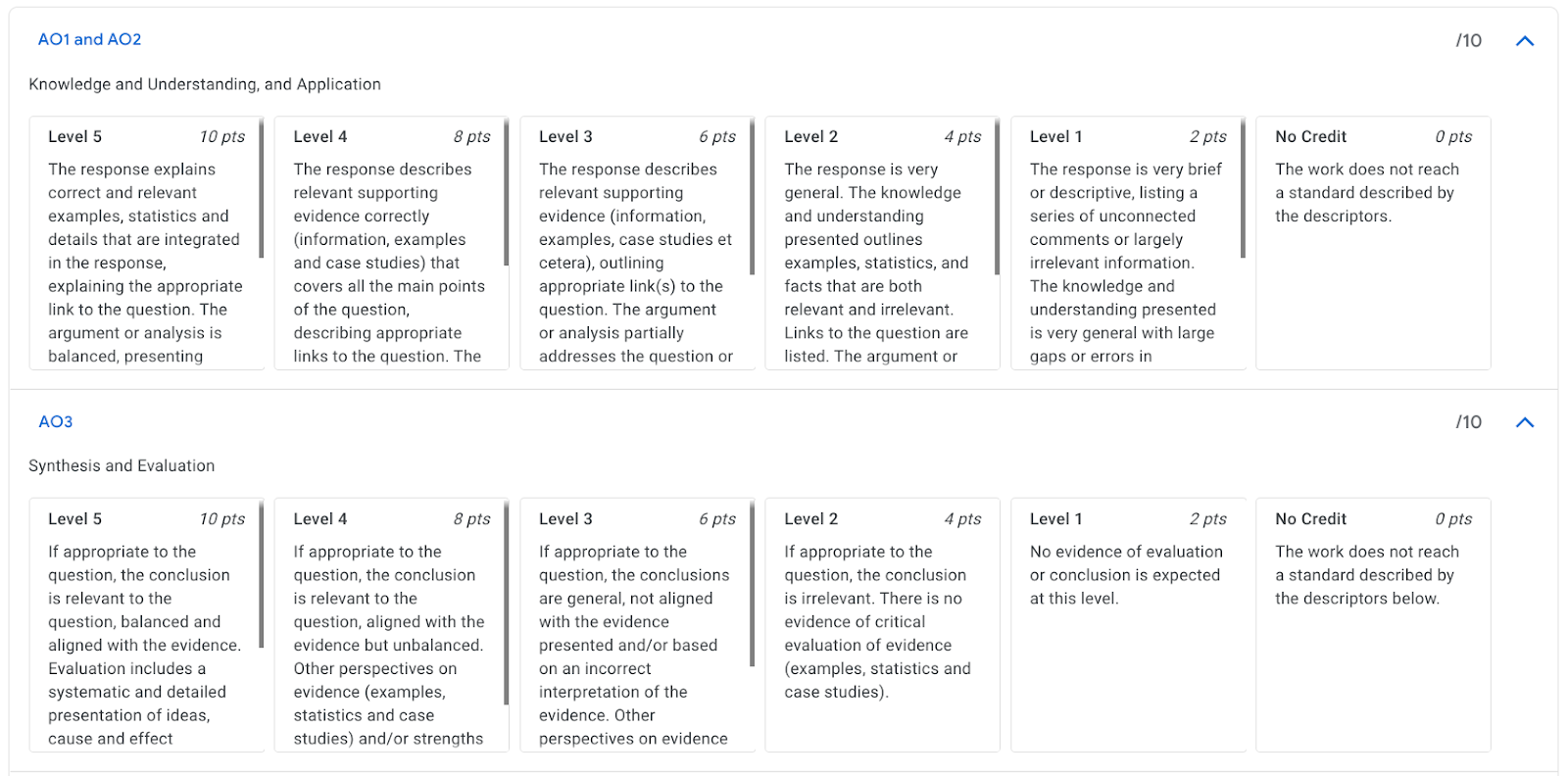
One of the great features of Google Classroom is ‘Rubrics’. Teachers can create, reuse and grade student work using rubrics for individual assignments. Rubrics are essentially mark schemes that can be added to your assignments, but can also be used by students as a success criteria. Rubrics can easily be shared between other teachers to avoid replication. 

Below is an example of a rubric used for providing feedback for IB extended answers in Geography. Each criterion relates to the assessment objectives, and provides clear guidance on how to achieve each level. 


The above rubrics has a score assigned, but the rubric can be adapted to be unscored. This may be used for grading effort or SPaG. 


The following video outlines:

  • How to make a rubric

  • How to assess work using a rubric

  • How to share your rubric with other teachers


For a demonstration of the above the video here will help:


For further information about how to use Rubrics, visit the Google for Education support page here. 

Using rubrics on Google Classroom 


WA Online - How To?


As a community we have created a wealth of knowledge about effective learning online including:

If you have any other "How To" videos please do share them with me so we can keep this updated!

Wednesday, 23 September 2020

Bitesize Research: The Impact of Technology on Student Learning

This week, I wanted to share with you a study published by the Abdul Latif Jameel Poverty Action Lab (based at the Massachusetts Institute of Technology in the US) in 2019.

Objectives of study: To establish what impact technology has on student learning in developed countries. 


Summary of findings:  

  • Educational software designed to help students develop particular skills at their own rate of progress have shown enormous promise in improving learning outcomes, particularly in Maths. 

  • There is some evidence to suggest that these programs can boost scores by the same amount as effective tutoring programs.

  • Technology based reminders (e.g. text messages sent home or emails to remind students to do something) have meaningful although modest impacts. As these are often low cost, this seems to be a worthwhile investment. 

  • Combining online and in-person instruction can work as well as traditional in-person only classes, which suggests blended learning may be a cost-effective approach for teaching. Students in online only courses, however, tend to perform worse than students in in-person-only courses.

  • Novel technologies for education e.g. using virtual reality, or virtual whiteboards have not yet had rigorous testing for their efficacy. 

How does this impact me and my practice?: Some reflections questions arising from this that might be helpful to consider are: 
  • How can I personalise instructions using technology and find ways of enabling students to progress at their own pace?

  • How can we use technology to nudge students and contact parents regularly?

  • How can we continue to ensure that we ensure our students use their Chromebooks with the greatest impact possible?

If anyone would like to discuss this further with me (Jaya) - please comment below! I’d be delighted to open up these discussions and conversations.

Wednesday, 8 July 2020

Thoughts from a Trainee

By Sophia Evans, Teach First Trainee in Maths


When I first joined the Teach First programme, I wasn’t entirely sure whether or not teaching would be a profession for me long-term. I had not had any prior experience in teaching and applied to Teach First on a whim, after a friend who was already on the programme suggested it to me. I had in my mind that I would just complete the two-year programme and most likely move out of teaching after that. I was incredibly nervous about starting at WA with only one week of experience in a school during summer institute; I think the best word to describe how I was feeling is clueless.


One of the strengths of WA is the high standard of teaching and I have seen some fantastic teachers demonstrate their craft on many occasions. However, I do feel that this can sometimes be a pitfall. I’m sure my fellow trainees will agree that being surrounded by such high quality teachers is incredible for development, but can also cause issues with confidence and self-esteem. Throughout the first few terms, and I am sure I am not alone with this, I felt like I wasn’t good enough. I could be doing more. This can be quite a burden to carry during your first few months in a profession with minimal experience.


Once I had begun to overcome my growing “imposter syndrome” and realised that I should be just focusing on my own teaching and learning, instead of comparing myself to others, I began to develop my teaching skills further. The team planned lessons that we use in maths already contain good pedagogical strategies but I think that for a while I was just teaching the slides, rather than really thinking about what I was doing, how it links to other areas of maths, and even how the slides could be improved for support and challenge. Taking the leap into editing and sometimes questioning things in the team planned lessons was quite difficult, initially I felt like I didn’t have enough experience to go off-piste. I also started observing colleagues more and would steal and adapt their fantastic ideas. I used a task from one of Ruhina’s Y10 lessons, where students had to construct a house using angle and line bisectors, as one of my observations from my UCL tutor. The lesson went extremely well and I think that it sparked this interest inside of me to try new things in my lessons!


Y10 Construction Task


I have thoroughly enjoyed discussions I have had with various people in the maths department about how and why we teach things the way we do. In particular, my mentor meetings with Tom would often end up with us discussing potential new ways of teaching a particular topic, or the questions we would ask and why it is good to ask them. Training in an environment where you are surrounded by knowledgeable people who enjoy discussing their subject and enjoy conversations about pedagogy has been one of the key factors in my development as a teacher. I feel fortunate to have this opportunity, especially as I have friends teaching in other schools who have certainly had different experiences with their departments. These discussions have helped me develop confidence in my own curriculum knowledge (as someone who didn’t study maths at university this is a big deal) and have also, I think, helped me teach better lessons where I have actually thought about what, how, and why the students are learning.


Having used Google Classroom since September, I felt almost an “expert” compared to my friends in other schools, which also meant that the completely daunting shift to WA Online was not as much of an obstacle as I thought it would be. I actually wrote a “google classroom guide” which was shared with some members of my Teach First maths cohort this year, which I NEVER thought I would be doing. I think that this confidence with utilising technologies has allowed me to become more creative with teaching strategies online, as I didn’t have to worry about the basics, and even led to me giving an INSET training session with Emma and Jojo. 


The switch to teaching online has highlighted to me how much I actually miss the classroom and the students. I believe that the situation of “all being in the same boat” has made some of the students more engaged in my lessons and has given me the opportunity to build stronger relationships with some of them. As part of my module 3 assignment I looked into effective teaching strategies for teaching online and attempted to implement metacognitive strategies into my lessons. If I was not as confident with teaching online, and built relationships with students in that they would be confident to be themselves in online lessons (answering questions and contributing to class discussions), I don’t think I would have been able to really focus on the intervention implementation as I would have been too busy stressing about the IT-side of the online lessons, instead of the content. I thoroughly enjoyed implementing metacognitive strategies, getting students to think about what they know and how they can implement it, and am excited to continue with this in my lessons in September.


I feel incredibly lucky to have spent my training year with you all, and massive shout outs go to the entire maths department (love you all), Divisha for being a great co-tutor to learn from, Ruhina for being the best DOL I could ask for and for Tom, my mentor who, I believe, is one of the main factors for sparking this passion of mine and making me change my mind about teaching long term. I cannot thank you guys enough. 


Here’s to being an NQT next year wahoooooo! Good luck to all the new trainees joining, you guys are very lucky to have WA at your side for your training!