Showing posts with label Remote teaching. Show all posts

Tuesday, 12 January 2021

Bitesize Research: Best Practice for Remote Learning

The second week in T3, I wanted to share with you the work of the Education Endowment Fund on Remote Learning


Objectives: In the first lockdown, the EEF aimed to synthesise existing studies that were relevant to remote learning to give advice on what best practices might support learning online. Whilst the findings are helpful, the EEF are keen to stress that the studies examined were not done within the same context as the COVID-19 pandemic, which means that use of professional judgement with remote learning still remains highly important.


Summary:  They found the following key tenets were common threads in the studies examined on remote learning:

1. Teacher quality is more important than how lessons are delivered

  • Ensuring normal elements of teacher effectiveness e.g. clear explanations, scaffolding and feedback is essential

  • There was no difference between teaching in real time, or teaching ‘asynchronously’ - what mattered most was how explanations built on previous learning and how pupil understanding was assessed thereafter

2. Peer interactions can provide motivation and improve learning

  • Things such as peer marking and feedback, sharing and collaboration on model answers were found to be helpful across a number of studies.

3. Supporting students to be able to work independently was helpful

  • Providing strategies that linked to metacognition was helpful across a number of studies

4. Different approaches to remote learning suit different content and tasks

  • For example, games for learning were helpful in MFL, but much less helpful in other subjects.

  • Similarly using technology to support retrieval practice and self-quizzing can help, but this is not a replacement for other forms of assessment


How does this impact me and my practice?: Some reflection questions arising from this that might be helpful to consider are: 


  • How can I impactfully sequence learning to ensure that online lessons build on each other successfully?

  • How can I ensure that I can facilitate peer interactions in WA Online?

  • What practices can be put into place to support students with metacognitions and independent learning processes?

  • What different tasks are best suited to my subject, the content I am teaching, and the skills I want the students to develop?

If anyone would like to discuss this further with Jaya - please comment below! I’d be delighted to open up these discussions and conversations.

Tuesday, 5 January 2021

Rubrics: A Guide

By Divisha Patel

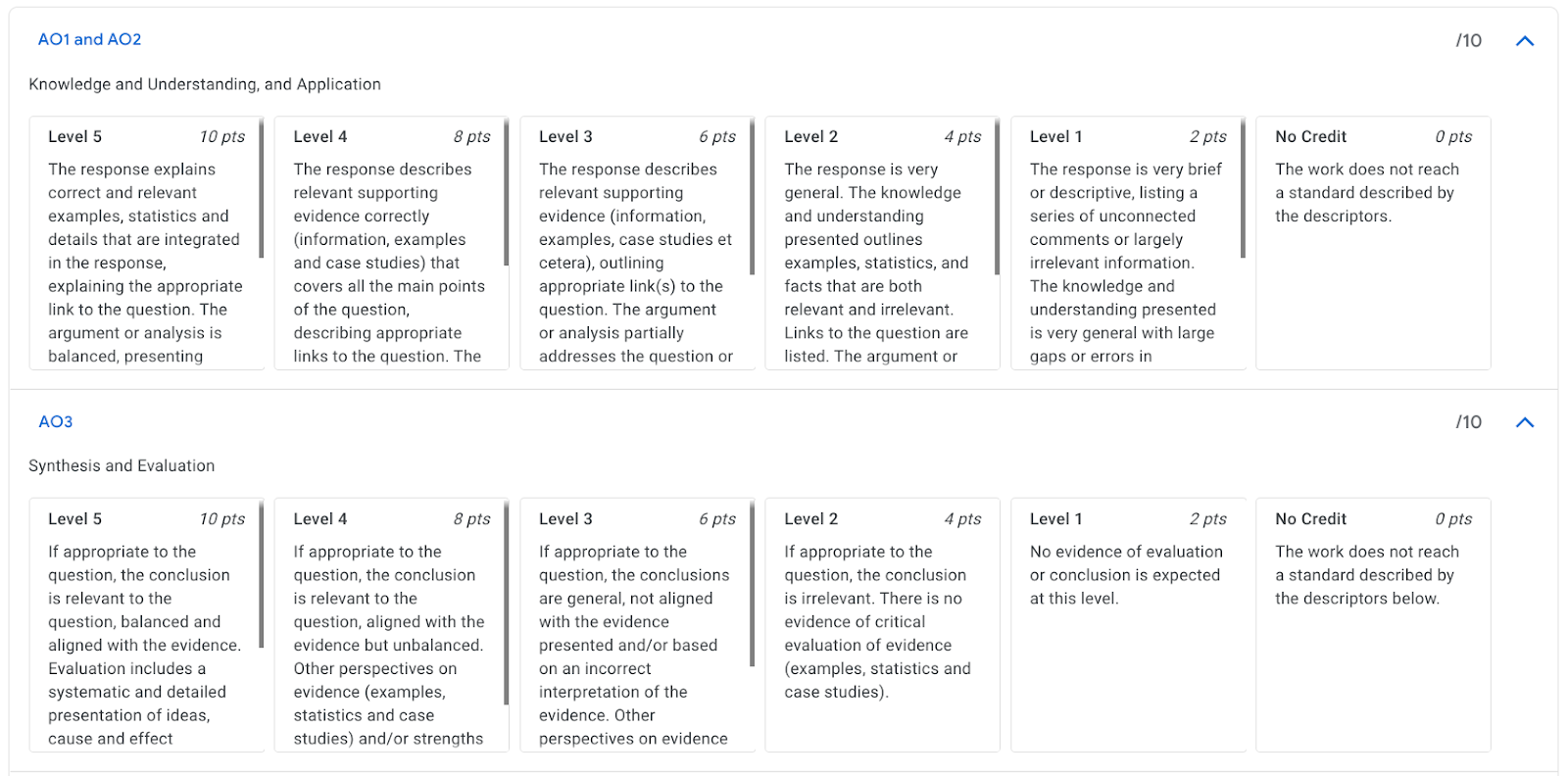
One of the great features of Google Classroom is ‘Rubrics’. Teachers can create, reuse and grade student work using rubrics for individual assignments. Rubrics are essentially mark schemes that can be added to your assignments, but can also be used by students as a success criteria. Rubrics can easily be shared between other teachers to avoid replication. 

Below is an example of a rubric used for providing feedback for IB extended answers in Geography. Each criterion relates to the assessment objectives, and provides clear guidance on how to achieve each level. 


The above rubrics has a score assigned, but the rubric can be adapted to be unscored. This may be used for grading effort or SPaG. 


The following video outlines:

  • How to make a rubric

  • How to assess work using a rubric

  • How to share your rubric with other teachers


For a demonstration of the above the video here will help:


For further information about how to use Rubrics, visit the Google for Education support page here. 

Using rubrics on Google Classroom 


WA Online - How To?


As a community we have created a wealth of knowledge about effective learning online including:

If you have any other "How To" videos please do share them with me so we can keep this updated!

Monday, 1 June 2020

Thoughts from a DoL

I consider myself fairly tech savvy - afterall I'm a maths teacher - we're a bit geeky about technology, right?


However, the government announcement of closing schools within three days meant we had to adjust to remote teaching at what felt like lightning speed. It also meant having to support a team of highly capable teachers in the same process at the same time - being a leader means at the very least being experienced enough to be able to coach and mentor your team through this change. Only, the catch is that I've never done this before - we're all on an equal footing learning at the same time, and it's an exciting but daunting chance to be a novice again. This was going to be a fast-paced, multi-dimensional learning experience!

Elements of my practice I would normally feel confident about, and therefore have been able to coach others on, now needed re-thinking when looked at through the perspective of a purely technological approach.

So I challenged my department to try different technology mediums to work on:
- Assessment for learning
- Feedback - verbal and written
- Questioning

I was encouraged by the examples of innovation I saw (NB: these will be featured in future blog posts in more detail): 
  • Teachers found ways of using the zoom chat like a mini whiteboard - by changing the settings so students can only message the teacher. This empowered students who would normally worry about incorrect answers to engage more actively, and gave the teacher the ability to praise and encourage participation. 
  • Using Quizizz and Google Forms as a means of low-stakes assessment in the lesson in place of mini whiteboard questions - mixing it up with allowing the students to see the answers straight away or not so the teacher can go through each question individually.
  • Converting worksheets into online versions, creating exit cards and assessed tasks, and setting them as assignments on Google Classroom to be handed in by the student to be marked and returned for follow up. 
  • Live teaching using a whiteboard over zoom to model concepts and methods, recreating the classroom feel with cold-calling. 
At the end of a few weeks of experimentation I feel extremely proud of how my department has adapted their practice, and the dynamism they have shown in finding multiple ways to assess, mark and give feedback. As a DoL it has made me reflect on the balance between wanting consistency in how we give feedback and marking through having a schedule and collaboratively planned assessment tasks, and giving teachers the freedom to give feedback and mark in a more organic, less-structured but equally effective way. 

In terms of Leadership it brings up questions like:
  • How would I monitor this more flexible approach to marking and feedback?
  • When we are back in the physical building where is the balance between feedback using technology and feedback in books? If there's a book scrutiny how does the feedback get evidenced? Is that an important factor to consider?
  • How do stakeholders (students, teachers, parents) feel about a more fluid feedback cycle? How do you ensure parents feel confidence in the feedback their child is getting if it's not in red pen in their books?
  • How would this fit in with the whole school policy and vision for feedback and marking? A discussion with SLT would need to take place so having some ideas and solutions to these questions ready would be the ideal way to start the conversation.
It's a really exciting time to be a DoL at WA tackling these questions and how we see our teaching and learning move forward post-lockdown. 


Resources spoken about in the post:
Zoom - www.zoom.us
Quizizz - www.quizizz.com
Google Classroom & Suite